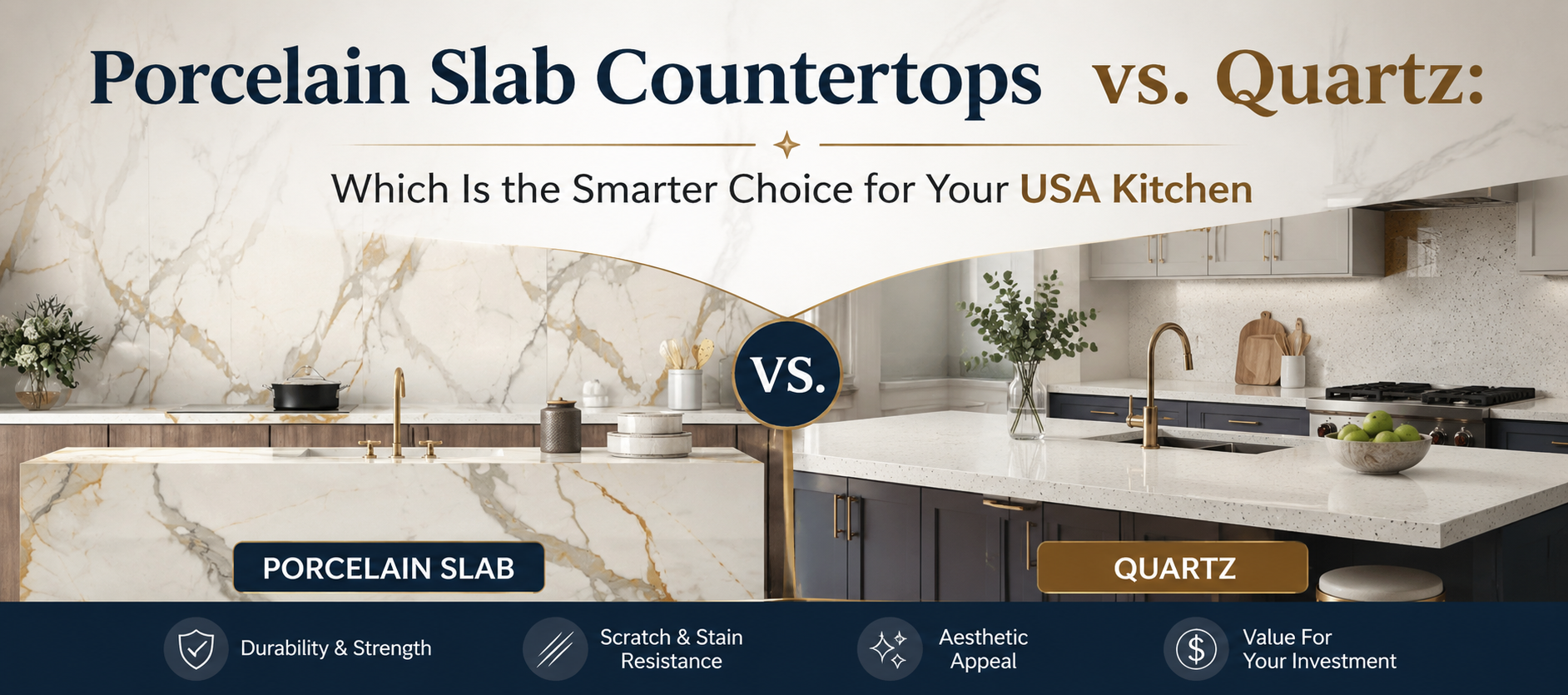
Porcelain Slab Countertops vs. Quartz: Which Is the Smarter Choice for Your USA Kitchen
After nearly two decades of quartz dominance in American kitchens, a quieter revolution has been building on showroom floors from New York to Los Angeles. Large-format porcelain slabs — once considered a niche European import — are now the fastest-growing countertop category in the USA, with industry data from KBIS 2026 pointing to double-digit year-over-year growth in porcelain surface installations across premium residential and commercial projects.
This shift is not a trend built on aesthetics alone. It is driven by a practical reckoning: homeowners and designers are asking harder questions about heat tolerance, UV exposure, outdoor applications, and the long-term cost of ownership. And on many of those fronts, the numbers are breaking in porcelain's favour.
This guide gives you a complete, no-bias breakdown of porcelain slab countertops vs. quartz — how the two materials compare across every variable that matters for a US kitchen in 2026, where each one excels, and how to make the right call for your specific project.
What Exactly Are Large-Format Porcelain Slabs?
The term "porcelain slab" is frequently misunderstood. This is not standard floor tile cut to countertop size. Large-format porcelain slabs are purpose-engineered panels manufactured from a refined mixture of kaolin clay, feldspar, silica, and mineral oxides. These raw materials are dry-pressed under extreme hydraulic pressure and then kiln-fired at temperatures exceeding 2,300°F to 2,600°F — a process that produces a surface far denser, harder, and more durable than conventional ceramic.
The result is a non-porous, near-zero-absorption slab that carries none of the vulnerability of natural stone. Water, oil, wine, and coffee cannot penetrate the surface. There is no sealing schedule to maintain. And because the manufacturing process is digitally controlled, today's porcelain slabs can replicate the veining of Carrara marble, the drama of Calacatta gold, or the warmth of concrete — with extraordinary realism.
What sets premium manufacturers apart is slab size. Lamar Ceramics, a specialist premium porcelain slab manufacturer, produces slabs in a 320 cm × 80 cm format — dimensions that allow fabricators to cover large kitchen islands in a single run, eliminating seams entirely on most standard US countertop layouts. That dimension is also why the category is increasingly referred to as large format porcelain slabs in the design and architecture community: the scale changes what is possible aesthetically and structurally.
Available thicknesses typically range from 6 mm (for wall cladding and overlay installations) through 12 mm and 20 mm for standard countertop use. The 20 mm profile is recommended for high-use kitchen surfaces and is what most US fabricators specify for durability.
Porcelain vs. Quartz Countertops: A Head-to-Head Performance Comparison
Both materials are engineered, non-porous, and positioned as premium choices for modern American kitchens. Both require no sealing and resist bacterial growth. But the similarities end there. Here is where the two diverge on the variables that determine long-term satisfaction.
Heat and UV Resistance: A Clear Winner Emerges
Quartz countertops are composed of approximately 90–95% natural quartz crystals bound together with 6–10% polymer resin. That resin is the Achilles heel of the material when it comes to heat. Resin softens and can scorch, discolor, or permanently mark at temperatures above 300°F — a threshold that a baking sheet pulled from a 400°F oven easily exceeds. This is why quartz manufacturers universally recommend trivets and heat pads, and why heat damage is consistently cited as the number one complaint among quartz countertop owners in US consumer reviews.
Porcelain contains no resin. It contains no organic binder of any kind. Having been manufactured at kiln temperatures above 2,300°F, it is thermally inert in any realistic domestic cooking scenario. A 500°F cast iron skillet placed directly on a porcelain surface will leave no mark, no discoloration, and no structural damage. For serious home cooks — and for any kitchen with proximity to an oven or range — this is not a marginal advantage. It is a fundamental difference.
On UV exposure, the gap is equally decisive. Quartz resin degrades under prolonged direct sunlight, causing yellowing and surface dullness. Every major quartz manufacturer explicitly excludes outdoor installations from product warranties. Porcelain is UV-stable and will not fade, yellow, or degrade regardless of sun exposure, making it the default choice for outdoor kitchens, patio installations, countertops near floor-to-ceiling windows, and sun-facing kitchen extensions increasingly common in Southern US markets.
Verdict on Heat & UV: Porcelain wins decisively. It handles direct heat and sun exposure that quartz cannot.Stain Resistance and Day-to-Day Maintenance
Both materials are non-porous, which means neither will absorb spills under normal use. Neither requires sealing at installation or at any point during the product's lifespan. For the vast majority of kitchen spills — coffee, wine, tomato sauce, oil — both surfaces will clean completely with a damp cloth and mild dish soap.
Where they differ slightly is in acid sensitivity. Quartz's resin content can be affected over time by prolonged contact with highly acidic substances, though this is rarely a concern under normal use. Porcelain, being entirely mineral-based, is fully acid-resistant. For kitchens where lemon juice, vinegar-based preparations, or acidic cleaners are used frequently and left to sit, porcelain offers marginally stronger long-term protection.
On edge chip vulnerability, quartz holds a practical advantage. The resin matrix gives quartz a degree of flexibility that absorbs impact at corners and edges, making chips less likely. Porcelain, despite being harder by surface measurement, is more brittle — a sharp impact on a thin porcelain edge can chip or crack the material. Choosing a 20 mm slab with a properly mitered edge significantly reduces this risk, but it is a factor worth understanding before installation.
Verdict on Maintenance: Both are low-maintenance. Quartz edges are more forgiving under impact; porcelain offers stronger acid resistance.Aesthetics and Natural Stone Replication
Quartz has traditionally held an advantage in pattern depth. Because the pigments and minerals are bound throughout the full slab thickness, quartz designs carry visual depth that continues through edges and cross-sections — a quality appreciated particularly when waterfall edges or detailed edge profiles are specified.
Modern digital printing technology has dramatically narrowed this gap for porcelain. Today's large-format porcelain slabs achieve levels of stone realism — in Carrara, Calacatta, Macchia Vecchia, and travertine patterns — that are visually indistinguishable from the real material at normal viewing distances. The additional advantage of porcelain's large format is continuity: a single slab can run from countertop to backsplash to feature wall with the same uninterrupted vein pattern, creating a cohesive design statement that quartz — limited by standard slab dimensions — cannot match.
Porcelain is also the more versatile material in terms of design vocabulary. Where quartz is largely limited to stone replication, porcelain can authentically replicate wood grain, concrete, textile, and metal finishes — a range of looks increasingly sought by contemporary interior designers specifying for modern US homes.
Quartz retains an advantage in edge profile variety. Its thickness and resin content allow fabricators to cut beveled, bullnose, ogee, dupont, and custom decorative edges. Porcelain's thinness restricts edge options primarily to mitered or squared profiles, with build-up techniques used to achieve a thicker appearance where needed.
Verdict on Aesthetics: Porcelain leads in scale and design continuity; quartz leads in edge options and through-slab depth.Installed Cost Comparison in the US Market (2026)
Cost Factor | Porcelain Slabs | Quartz |
Material cost (starting) | ~$25/sq ft | ~$30/sq ft |
Installed cost range | $40–$120/sq ft | $50–$200/sq ft |
Typical kitchen (30–40 sq ft) fully installed | $1,200–$4,800 | $1,500–$6,000 |
Fabricator availability (USA) | Growing; specialist required | Wide; most countertop shops |
Labor premium | Possible in some regions | Standard market rate |
Porcelain slab material costs less than quartz at the entry level, but installation often requires a specialist fabricator experienced in handling thin, brittle panels — not every countertop shop in the US works with large-format porcelain. In areas with limited porcelain fabrication expertise, labor premiums can offset the material cost advantage. As the US porcelain market matures through 2026, this gap is narrowing, particularly in major metropolitan areas. For premium slab grades from established manufacturers, the two materials sit in broadly comparable total installed cost territory.
Seam Visibility and the Large-Format Advantage
This is where large porcelain countertops offer a genuinely unique advantage that quartz cannot match. Standard quartz slabs max out at dimensions that require seams on any kitchen island longer than approximately 10 feet. Large-format porcelain panels — particularly those in the 320 cm format — can cover those same spans in a single continuous sheet, with no visible joint breaking the stone pattern.
For open-plan kitchen designs, large waterfall islands, and commercial hospitality installations, seam minimization is not just an aesthetic preference. It is a hygiene, maintenance, and longevity consideration. Seams are potential points of moisture ingress, cleaning difficulty, and visible aging. Eliminating them where possible is a direct quality upgrade that large-format porcelain makes achievable at a viable price point.
Why Porcelain Slabs Are the Countertop Story of 2026 in American Kitchens
The 2026 kitchen countertop trends tell a consistent story: the American market is moving toward surfaces that perform as well as they look, and porcelain slabs are positioned squarely at that intersection. Searches for porcelain countertops have more than doubled over the past seven years according to industry tracking data, and the trajectory is accelerating as more US homeowners experience the material firsthand in showrooms and completed renovations.
Several macro forces are driving this shift:
- The outdoor kitchen boom. Post-pandemic renovation priorities in Sun Belt states have pushed outdoor cooking spaces into mainstream residential projects. Quartz cannot be used outdoors. Porcelain can — without compromise.
- Large open-plan kitchens. As island sizes grow and kitchen-living integrations deepen, the pressure to minimize visible seams grows with them. Large-format slabs answer this demand.
- The sustainability lens. Porcelain is manufactured entirely from natural minerals with no synthetic resin binders. It carries an advantage in environmental certification frameworks — relevant to the growing segment of US buyers factoring material sustainability into specification decisions.
- Design continuity. The "slab everything" trend in contemporary kitchen design — where countertop, backsplash, and feature wall share a single material — is only achievable at scale with large-format porcelain.
- OSHA regulatory pressure on engineered stone. Heightened scrutiny on silica dust exposure during quartz fabrication is creating procurement hesitation among some US commercial buyers and architects, opening the door wider for porcelain alternatives.
Top Porcelain Slab Styles Performing in the US Market Right Now
The visual story of porcelain has evolved significantly. The most-specified patterns in US residential projects in 2026 draw heavily on Italian marble aesthetics — a preference that aligns precisely with what large-format porcelain technology does best. Here are the four design directions dominating American kitchen and bathroom porcelain countertops projects:
Carrara White — The Enduring Classic
Soft white ground with fine grey veining. The Carrara look remains the most-specified porcelain pattern in the US, appearing in everything from farmhouse renovations in the Midwest to minimalist new builds on the East Coast. Lamar Ceramics produces both a Carrara and Carrara Ultimo variant in the 320 cm format — the latter carrying bolder, more dramatic veining for clients who want impact without committing to full Calacatta contrast.
Calacatta Gold — The Statement Surface
Warm white background with thick, sweeping gold and grey veins. The Calacatta look is the choice for kitchen islands intended to function as visual focal points. In a large-format slab, Calacatta veining can be book-matched across panels for a symmetrical, gallery-quality result. Lamar's Calacatta brings this look to the 320 × 80 cm format.
Macchia Vecchia — The Dramatic Contemporary Option
Cloud-like formations of grey and charcoal on a lighter ground. The Macchia pattern is experiencing rising specification rates in contemporary American architecture, particularly in kitchens where the countertop and cabinetry system uses matte whites or warm wood tones. The Lamar Macchia slab provides the scale needed to let this pattern breathe properly.
Black Porcelain — The High-Impact Specification
For clients pursuing a maximalist or industrial aesthetic, black porcelain countertops in large-format deliver a drama that no other material category can match. A full-run black porcelain island in a white kitchen is one of the highest-impact single design decisions a homeowner can make — and the maintenance profile of porcelain makes the finish genuinely practical, not just aspirational.
Is Porcelain the Right Choice for Your Kitchen? A Decision Checklist
Rather than making a blanket recommendation, the honest answer is that the right countertop material depends on your specific use patterns, design priorities, and project context. Here is a practical decision framework:
Choose porcelain if you:
- Cook frequently with high heat and prefer not to use trivets
- Have a kitchen with direct sun exposure, skylights, or a south-facing island
- Are specifying an outdoor kitchen or covered patio countertop
- Want a large island or peninsula with no visible seams
- Are planning a design where countertop and backsplash share the same material
- Value zero maintenance — no sealing, no specialist cleaning products
- Want a surface extending into the bathroom porcelain countertops for bathroom and shower panels for design continuity
- Have sustainability or LEED considerations as part of your project spec
Quartz may be the better choice if you:
- Want the widest possible range of edge profiles for a traditional or transitional kitchen
- Need the fastest possible fabrication and installation turnaround
- Are concerned about edge chipping from heavy use or young children
- Have a smaller project where quartz fabrication availability is a genuine convenience factor
- Prioritize pattern depth visible at edges and in cross-section
How to Evaluate a Porcelain Slab Supplier for a US Project
The quality gap between porcelain slab suppliers is real and consequential. A premium 320 cm slab from a precision manufacturer and a budget tile-grade slab may share a category name but diverge substantially in surface density, color consistency, dimensional tolerance, and edge finish quality. As you evaluate options, here is what to verify:
Slab Size and Format Capability
Not all suppliers manufacture at true large-format dimensions. For a US kitchen island of any meaningful scale, you need access to large format porcelain slabs in the 300–320 cm range. Suppliers unable to provide this dimension will require seams that a proper large-format specification avoids entirely.
Product Certification
For US market supply, verify that the manufacturer's slabs meet ANSI A137.3 standards for gauge porcelain tile panels and carry appropriate food-safe surface certifications if the countertop will be used for direct food preparation. Ask specifically about water absorption rates — a genuine vitrified porcelain should test below 0.5%.
Design Range and Sampling
A manufacturer with a serious design program will be able to provide physical samples at full slab scale — not catalog images — before a large project is committed. Vein pattern consistency across multiple slabs from the same production run matters when book-matching or tiling a large countertop and backsplash together.
Supply Reliability for Commercial and Repeat Orders
For B2B buyers — interior designers, developers, kitchen and bath showrooms — supply consistency is as important as product quality. Verify that a prospective supplier has the manufacturing capacity and inventory management to support phased project delivery. Lamar Ceramics operates as a manufacturer-direct supplier, which offers the consistency and precision control that trade buyers require for large-scale residential and commercial specifications.
Application Versatility
The best porcelain slab suppliers support the full range of architectural applications — not just kitchen countertops. If your project includes wall cladding, shower panels, or outdoor surfaces in addition to countertops, a supplier whose slabs perform across all of these reduces the material and supplier complexity of the project significantly.
The Bottom Line: Which Material Is Right for Your 2026 Kitchen?
Quartz has earned its position as America's most popular countertop material through a decade of proven performance, wide availability, and broad design choice. For a buyer who values edge durability, established fabrication networks, and full-depth pattern consistency, quartz remains a sound specification — particularly in kitchens that will not see direct sun exposure or outdoor use.
But for buyers designing kitchens that need to perform at the highest level — across heat, UV, scale, and maintenance — the data in 2026 points consistently toward porcelain slab countertops vs. quartz as a competitive exercise that porcelain wins on the metrics that matter most for serious cooking environments and contemporary design briefs.
The decisive factors are heat tolerance (no trivets, no scorching), UV stability (indoor and outdoor use without warranty exclusions), seam elimination at large scale, and the ability to extend a single material logic across countertops, backsplashes, walls, and bathroom surfaces for a cohesive, high-end result.
For US buyers seeking manufacturer-direct access to premium large-format porcelain slabs — including Carrara, Calacatta, Macchia, and black finishes — Lamar Ceramics offers the 320 cm × 80 cm format that makes seamless large-scale installations achievable without compromise.
Frequently Asked Questions
Are porcelain slab countertops better than quartz for kitchen use?
Porcelain slab countertops outperform quartz in heat resistance, UV stability, and outdoor durability. Quartz countertops offer superior edge durability, wider fabricator availability, and consistent through-slab patterning. The best choice depends on your cooking habits, kitchen design, and whether the installation includes outdoor or high-sun exposure areas.
Can you place hot pans directly on a porcelain countertop?
Yes. Porcelain is fired at temperatures exceeding 2,300°F during manufacturing, making it fully heat-proof in everyday kitchen use. Hot pans, baking dishes, and skillets can be placed directly on a porcelain surface without risk of scorching or discoloration. Quartz, which contains polymer resins, can scorch or permanently mark above 300°F.
How much do porcelain slab countertops cost compared to quartz in the USA?
In 2026, porcelain slab countertops cost approximately $40 to $120 per square foot installed, while quartz countertops range from $50 to $200 per square foot installed. For a standard US kitchen with 30–40 square feet of countertop space, a fully installed porcelain project typically costs between $1,200 and $4,800, compared to $1,500 to $6,000 for quartz.
Do porcelain slab countertops require sealing or special maintenance?
No. Porcelain is non-porous by nature and requires zero sealing — ever. Routine cleaning with mild soap and water is all that is needed. Unlike natural stone surfaces, porcelain will not absorb stains, bacteria, or moisture over time, making it one of the lowest-maintenance countertop options available for American homes.
What sizes do large-format porcelain slabs come in for countertop use?
Large-format porcelain slabs for countertops are typically available in panels up to 126 inches (approximately 320 cm) long, far exceeding standard quartz slab dimensions. Lamar Ceramics manufactures slabs in a 320 cm × 80 cm format, allowing for seamless countertop runs on large kitchen islands with minimal or no visible seam lines.
-
 May 22nd, 2026
 -
 April 24th, 2026
 -
 April 24th, 2026