Porcelain Slab Countertops: Everything U.S. Homeowners Need to Know Before Buying
Porcelain has moved from a niche import product to one of the fastest-growing kitchen countertop materials in the United States, and homeowners researching a remodel now need real numbers, not marketing claims. This guide covers what porcelain slabs actually are, how they measure up against quartz and granite on cost and durability, what sizes and thicknesses fabricators typically stock, and how to plan an installation that holds up for decades.
What Is a Porcelain Slab Countertop?
A porcelain slab countertop is a large-format surface made from natural clays and minerals compressed under extreme pressure and fired at temperatures often exceeding 2,200°F. The firing process produces a dense, low-porosity material that resists stains, scratches, heat, and UV fading better than most traditional stone surfaces, without ever needing to be sealed.
How Porcelain Compares to Other Kitchen Countertop Materials
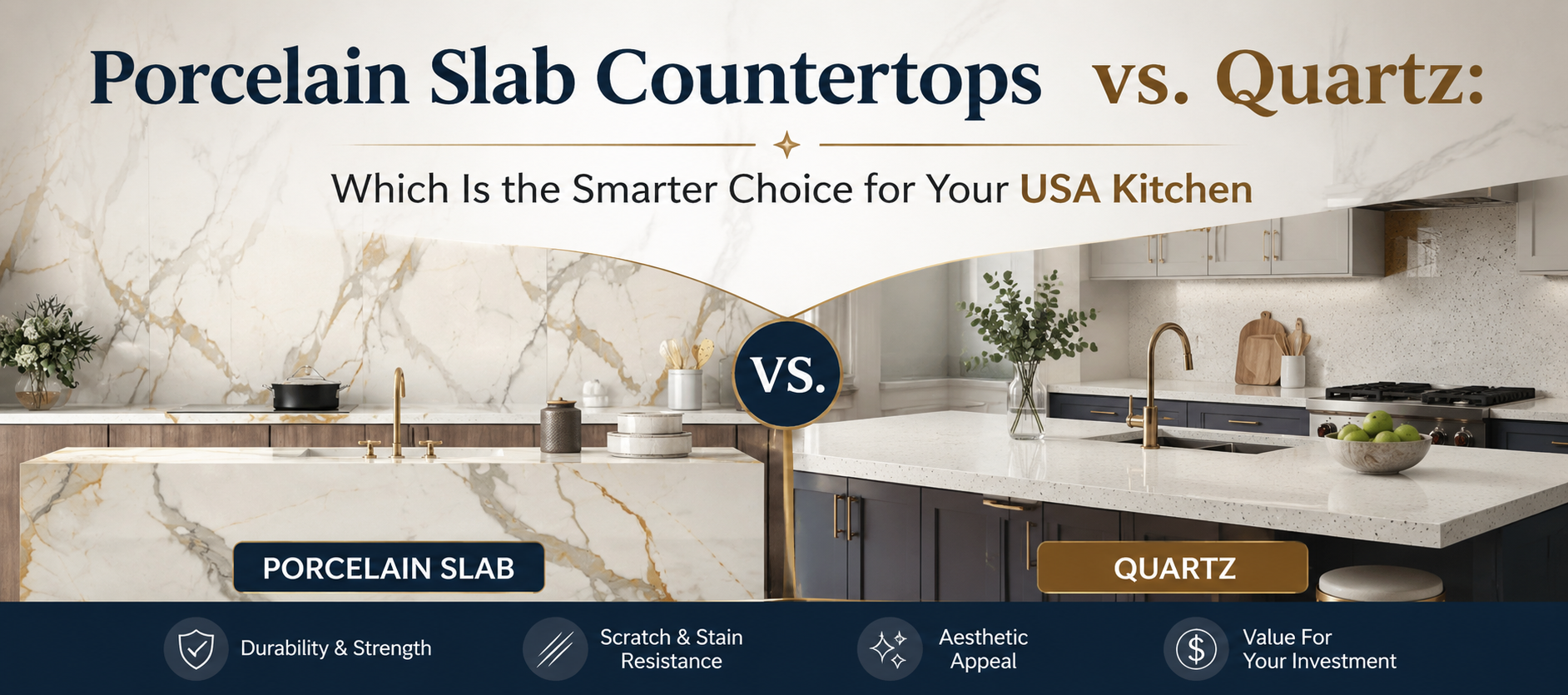
Among today's countertop options, porcelain stands out for its near-zero porosity and resistance to UV exposure, while quartz leads in color consistency and granite offers natural mineral variation. Each material trades off differently on cost, maintenance, and long-term performance, which is why the right choice depends on how a kitchen is actually used.
- Porcelain: Nonporous, UV-stable, heat- and scratch-resistant, no sealing required; more prone to edge chipping under sharp impact.
- Quartz: Engineered from roughly 90-93% crushed quartz bound with resin; consistent patterning but can discolor under prolonged direct sun and is sensitive to high heat.
- Granite: Natural stone with unique veining; heat-resistant but porous, requiring sealing every one to three years depending on the stone.
Choosing among these surface options ultimately comes down to weighing daily use against long-term upkeep, since a surface that needs less maintenance can still cost more upfront.
Slab Sizes and Thickness: What to Expect
Porcelain slabs are typically manufactured in large-format sheets, commonly around 1,600 x 3,200 mm, which allows for expansive, nearly seamless countertop runs. This size range is what makes porcelain a practical choice for large kitchen countertops where minimizing visible seams is a design priority.
Thickness options generally run from 6mm thin-body panels used for backsplashes and wall cladding up to 20mm full-body slabs built for countertops and high-traffic surfaces. For most residential kitchens, a 12mm to 20mm slab strikes the right balance between structural strength and a substantial, modern edge profile, while thinner 6mm to 9mm panels suit vertical applications rather than work surfaces.
Durability, Heat, and Stain Resistance: The Real Numbers
Porcelain's low porosity means it does not absorb liquids the way granite or marble can, which is why it resists staining from wine, oil, and acidic foods without any sealant. It also withstands direct heat from cookware far better than quartz, whose resin content can scorch or discolor under a hot pan.
The trade-off is impact resistance at the edges and corners. Because porcelain is harder and less flexible than quartz, industry fabrication data shows breakage rates during cutting and installation running around 5% to 8%, compared to roughly 1% to 2% for quartz, which is why professional installation matters more with this material than with most others.
Porcelain Countertop Cost in the U.S.
Installed porcelain countertops in 2026 typically fall in the range of $70 to $150 per square foot, depending on slab thickness, finish, and fabrication complexity, which places porcelain roughly in line with mid-to-premium quartz. For comparison, quartz generally runs $50 to $150 per square foot installed, and granite runs $40 to $175 per square foot installed, with high-end exotic slabs of either material pushing well past that range.
Because porcelain fabrication requires specialized CNC tooling and carries a higher breakage risk than quartz or granite, many fabricators build in a surcharge of roughly 15% to cover that added risk. Homeowners comparing quotes should ask whether this is itemized separately or folded into the per-square-foot material price.
Best Rooms and Applications for Porcelain Slabs
Porcelain's resistance to moisture, heat, and UV exposure makes it suited to more than just kitchen work surfaces. A well-planned porcelain countertop kitchen can extend the same slab material to a waterfall island edge, backsplash, and even an outdoor cooking area without any change in performance.
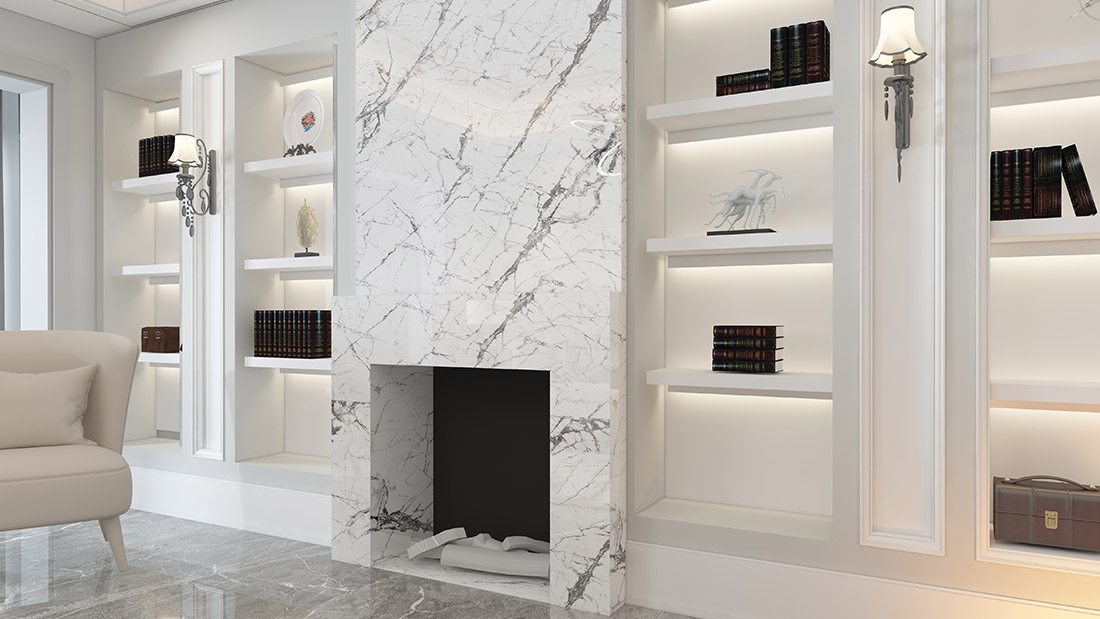
Because the surface does not require sealing and holds up in wet environments, porcelain has also become a common choice for shower walls and vanity tops. Homeowners planning a full bathroom and kitchen remodeling project often specify one porcelain collection across both spaces to keep the material palette consistent from room to room.
Installation and Fabrication Considerations
Porcelain fabrication is not interchangeable with quartz or granite fabrication. It requires porcelain-specific CNC programming, slower cutting speeds, and diamond tooling suited to the material's hardness, along with a fabricator who has direct experience handling large-format sheets.
Before hiring a fabricator, confirm they have completed prior porcelain installations, can show examples of finished seams and edge details, and carry adequate slab-breakage coverage. A rushed or inexperienced installation is the most common source of chipped edges and misaligned seams on porcelain projects.
Porcelain vs. Quartz vs. Granite: A Step-by-Step Decision Guide
- Define the primary use. Heavy cooking with hot pans and knives favors porcelain or granite over quartz.
- Check sun exposure. Kitchens with large windows or outdoor kitchens favor porcelain, since quartz can discolor under sustained UV light.
- Weigh maintenance tolerance. Granite needs periodic sealing; porcelain and quartz do not.
- Compare seam goals. Large-format porcelain slabs minimize visible seams across wide islands better than most standard quartz or granite slabs.
- Set the budget range. Mid-to-premium porcelain, quartz, and granite now overlap heavily in the $70 to $150 per square foot range, so material choice should follow performance needs rather than price alone.
Care and Maintenance
Porcelain countertops need little more than routine cleaning with warm water and mild soap. Because the surface is nonporous, everyday spills wipe away without staining, and there is no resealing schedule to track, unlike granite or marble.
Cutting boards and trivets are still recommended, not because porcelain scratches or burns easily, but because protecting the polished finish and edges extends the surface's appearance over decades of daily use.
Choosing a Fabricator for Large-Format Slabs
Working with large porcelain countertops requires a fabricator comfortable handling oversized sheets, precise seam placement, and integrated sink or cooktop cutouts without compromising the slab's structural integrity. Ask any prospective fabricator to walk through their process for handling, transporting, and template-fitting large-format material before signing a contract.
For homeowners weighing broader kitchen and bathroom renovations, porcelain's consistency across large runs also simplifies design planning, since one slab collection can often cover countertops, backsplashes, and wall panels without hunting for a matching secondary material. Browsing current kitchen design inspiration galleries before finalizing a layout can also help homeowners settle on a finish and edge profile ahead of fabrication.
Frequently Asked Questions
Are porcelain countertops worth it for a kitchen?
Porcelain countertops are worth considering for kitchens that see heavy cooking, direct sunlight, or frequent spills, since the material resists heat, staining, and UV fading without sealing. The main trade-off is a higher risk of edge chipping compared to quartz, so professional installation is essential.
How thick should a porcelain countertop be?
Most residential kitchen countertops use 12mm to 20mm porcelain slabs, which balance strength with a substantial edge appearance. Thinner 6mm to 9mm panels are better suited to backsplashes and wall applications rather than load-bearing work surfaces.
Is porcelain more expensive than quartz or granite?
Porcelain typically costs $70 to $150 per square foot installed, which overlaps with mid-to-premium quartz at $50 to $150 and sits above standard granite at $40 to $175. Final pricing depends heavily on slab thickness, finish, and fabrication complexity.
Does porcelain scratch or chip easily?
Porcelain resists surface scratching better than granite or quartz because of its density, but its rigidity makes edges and corners more vulnerable to chipping from sharp impacts. Industry data shows porcelain breakage during fabrication runs around 5% to 8%, compared to 1% to 2% for quartz.
Can porcelain slabs be used outdoors?
Yes, porcelain's UV resistance and low porosity make it a common choice for outdoor kitchens and covered patios, where sun exposure and moisture would degrade many other countertop surfaces over time. It does not fade, warp, or absorb water the way some engineered surfaces can.
Summary
Porcelain slab countertops offer a nonporous, UV-stable, and heat-resistant alternative to quartz and granite, with 2026 installed pricing generally running $70 to $150 per square foot. The material performs best in kitchens and bathrooms where large-format, low-maintenance surfaces are a priority, provided installation is handled by a fabricator experienced with porcelain-specific tooling and handling requirements.
-
 May 22nd, 2026
 -
 April 24th, 2026
 -
 April 24th, 2026